The Data Center Gold Rush
700 billion in global investment. Six classic bubble indicators. And Jerome County is sitting right in the path.
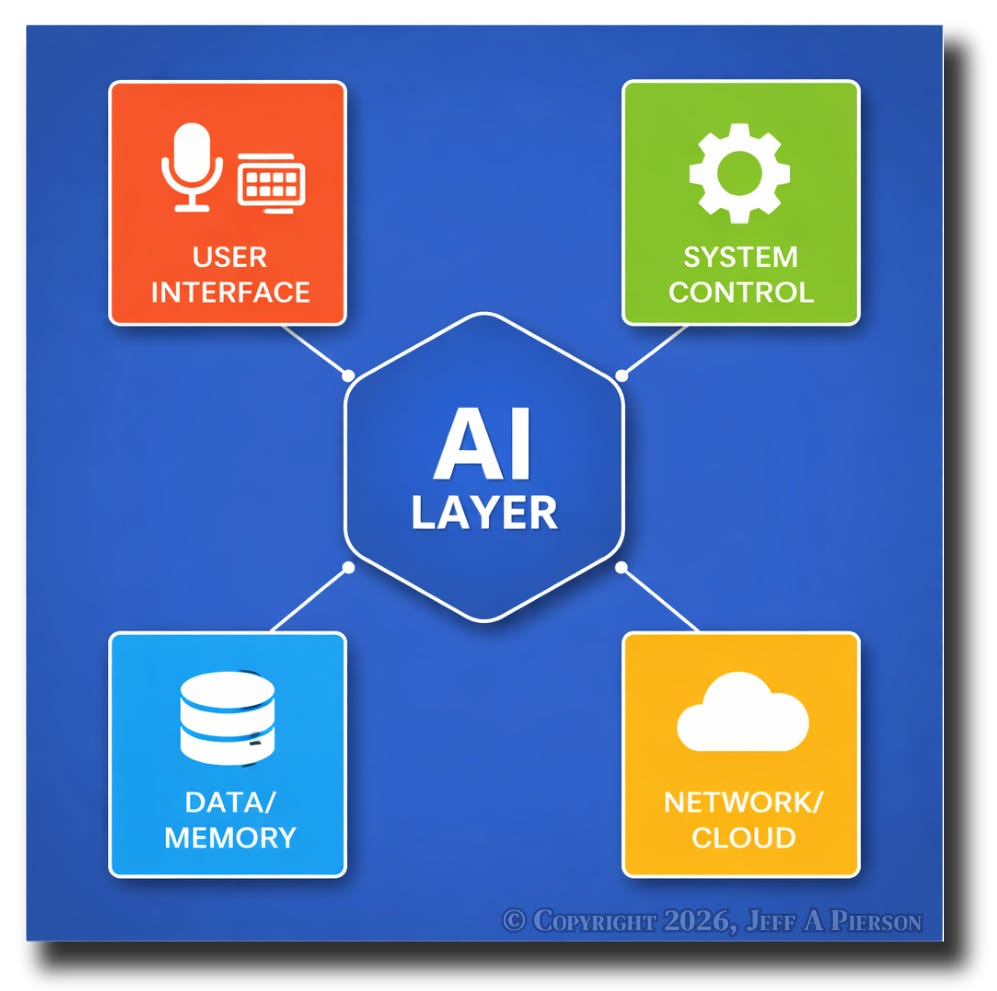
In 2024 and 2025, the world's largest technology companies committed an estimated $700 billion to data center construction. Microsoft, Google, Amazon, and Meta are building facilities at a pace not seen since the fiber-optic boom of the late 1990s. Goldman Sachs called it "the largest infrastructure buildout since the industrial revolution." The Yale School of Management asked a more uncomfortable question: "Is this a bubble?"
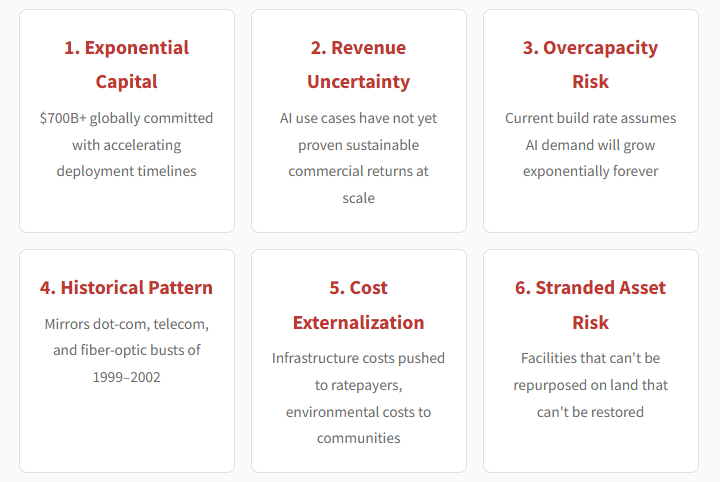
The citizen created, Jerome County Energy Ordinance Reform Package doesn't claim to know the answer. What it does claim — with substantial evidence — is that the data center boom has all six structural characteristics of a speculative bubble, and that communities like Jerome County should be planning for the possibility that the music stops.
The Six Bubble Indicators
None of these indicators, taken alone, proves a bubble. Taken together, they describe a market environment where the downside risks are enormous and entirely borne by local communities — while the upside benefits flow to shareholders in San Francisco and Seattle.
Lessons from the Dot-Com Bust
If this comparison seems alarmist, consider what happened the last time the technology industry built massive infrastructure on speculative demand. In the late 1990s, telecommunications companies laid millions of miles of fiber-optic cable based on projections that internet traffic would grow exponentially forever. When the dot-com bubble burst, an estimated 95% of that fiber went dark. Companies like WorldCom and Global Crossing went bankrupt. The communities that had rezoned land, granted tax breaks, and built out infrastructure to attract these companies were left with nothing — empty buildings, broken promises, and no tax revenue to show for it.
The data center boom has an eerie parallel. The AI models driving current demand are extraordinarily expensive to train and operate. The revenue models are unproven. The efficiency gains in AI hardware are moving faster than the build cycle — meaning facilities being designed today may be partially obsolete before they’re completed. Goldman Sachs’s own research arm has published analyses questioning whether AI will generate enough revenue to justify the infrastructure investment.
"The question isn't whether Jerome County should benefit from technology investment. The question is who bears the cost if the investment doesn't pan out."— From the Data Center Crisis Position Paper
The Moratorium Wave
Jerome County isn’t the only place asking these questions. Across the country, communities are hitting the pause button. Kootenai County imposed a 182-day moratorium in 2025 and is now considering a total ban. Jerome Township in Ohio — the ironic namesake — imposed a nine-month pause on new data center development in September 2025. Multiple councils across Georgia, Illinois, Kentucky, Ohio, Tennessee, Missouri, and Pennsylvania have introduced moratoriums or denied ordinance changes that would permit data center construction.
In Idaho specifically, the legislature introduced HB 895 to restrict data center water use and a bipartisan bill to limit the tax exemptions that data centers receive. The politics are shifting fast — and they’re shifting because communities are realizing that the “economic development” pitch doesn’t hold up when you look at the actual cost-benefit equation.
Why Decommissioning Bonds Are Non-Negotiable
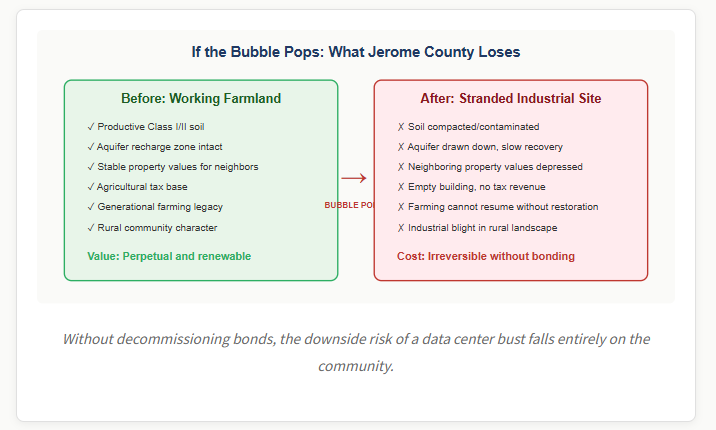
The reform package’s answer to the bubble risk is simple and proven: require decommissioning bonds set at 125% of estimated restoration costs before any permit is issued. This isn’t a radical idea. It’s standard practice in the mining industry, the oil and gas industry, and nuclear energy. The principle is straightforward — if you’re going to alter land, you should guarantee you can put it back.
In the community survey, 90.8% of respondents rated decommissioning financial assurance as “Extremely Important.” That near-unanimity tells you something important: people in Jerome County understand risk. They’ve seen what happens when companies make promises without collateral. And they’re not willing to bet their county’s future on the assumption that the AI boom will last forever.
The bottom line: The data center boom may be transformative. It may also be a bubble. The reform package doesn't ask Jerome County to bet on either outcome. It asks the county to require that anyone who wants to build on our land guarantees they'll clean up after themselves if it doesn't work out. That's not anti-business. That's common sense.
Send this to your commissioners and legislators, let them know what you think!
Sources
- Originally published on Substack: https://jeffapierson.substack.com/p/the-data-center-gold-rush