Idaho Power / SWIP-N Point by Point Rebuttal
Part 1 - Idaho Power Points 1 - 4, (9 more coming soon)
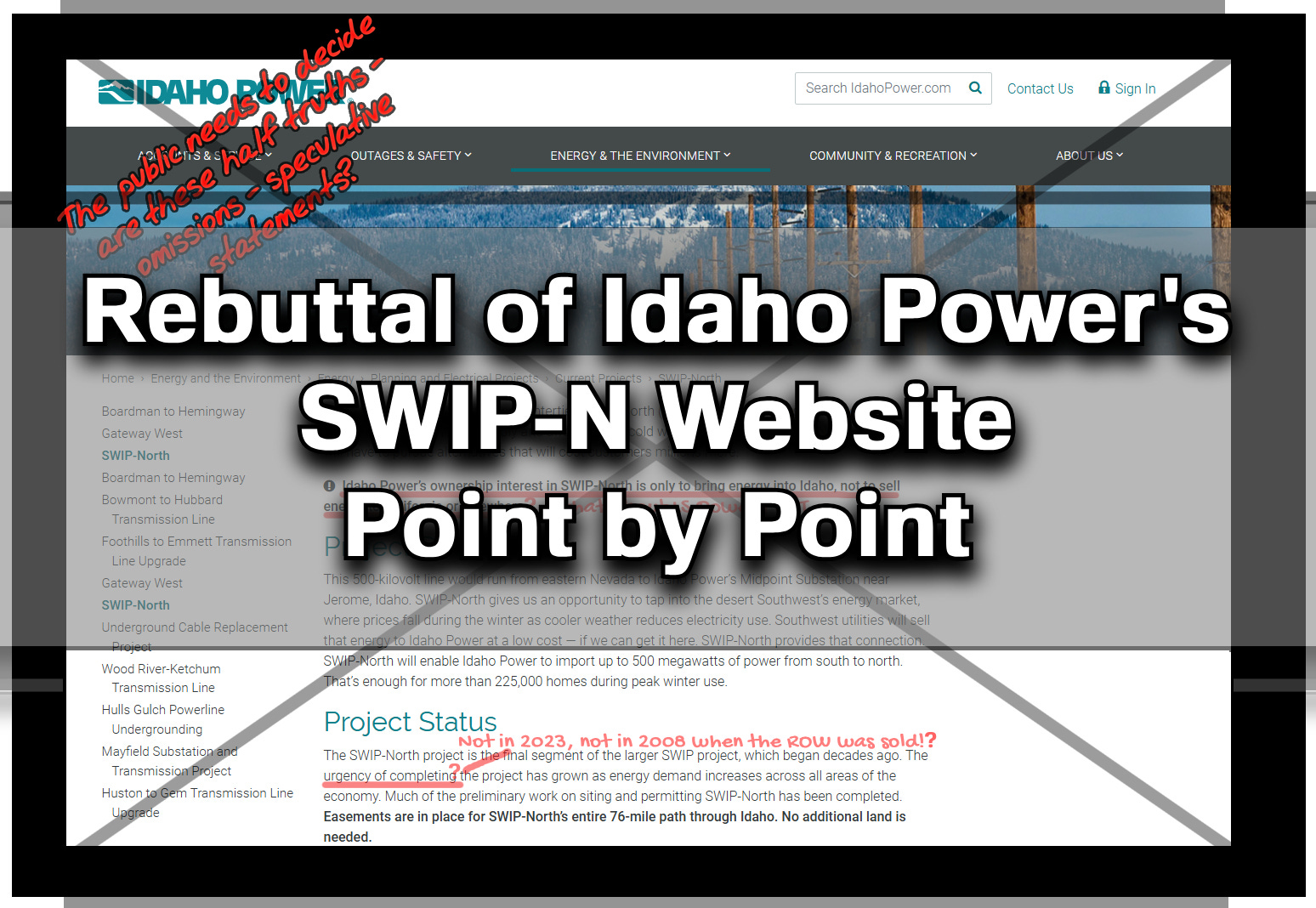
Outreach or Overextension?
Idaho Power has launched a significant outreach effort to promote SWIP North as a beneficial project for all Idaho customers. The company’s website and public materials describe SWIP North as a necessary investment that will keep winter energy costs manageable and ensure reliable service for homes, farms, and small businesses. This simplified narrative is designed to give the public confidence that Idaho Power is acting in their interest and to minimize concern about the scale and purpose of a high voltage transmission line that crosses multiple counties.
Most Idaho residents are not familiar with transmission planning, resource portfolio modeling, or the distinctions between local and regional power flows. Idaho Power’s outreach relies on this unfamiliarity. By presenting SWIP North as a straightforward reliability measure, the company sidesteps the deeper motivations that appear in its filings with the Idaho Public Utilities Commission and federal agencies. Idaho Power does not emphasize the unprecedented level of new industrial load that is shaping its planning, including Micron’s major semiconductor expansion in Boise and the introduction of several large data centers. These projects alone account for a significant portion of the one thousand megawatt increase in peak load Idaho Power projects within the next five years.
The company’s outreach also avoids discussing SWIP North’s role as part of a larger regional transmission corridor developed by LS Power and positioned to interact with regional energy markets. Instead, the message is narrowly focused on winter reliability and customer affordability. This framing shields the public from the full context of the project and deflects criticism that the line may primarily serve large industrial loads and regional transmission goals, rather than the everyday needs of residential customers.
This point by point review analyzes Idaho Power’s public claims and measures them against the official record. The goal is to ensure that Idahoans have a clear and accurate understanding of why SWIP North is being advanced and who stands to benefit from its construction.
Idaho Power - Point 1
“Idaho Power needs SWIP-North to meet customers’ energy needs reliably and affordably on cold winter days. Without SWIP-North, Idaho Power will have to pursue alternatives that will cost customers millions more.”
Response: Speculative at best!
Idaho Power’s own planning documents do not support the claim that SWIP-North is indispensable. In the 2023 Integrated Resource Plan (IRP), the company describes SWIP-North as a potential 500 kV line connecting Idaho to Nevada, but it states plainly that “Idaho Power’s potential involvement in the project remains uncertain and, therefore, the SWIP-N project is not included in the Preferred Portfolio of this IRP.” That filing, acknowledged by the Idaho Public Utilities Commission in Case IPC-E-23-23, appears to treat SWIP-North as an optional resource among many, not as a linchpin without which the system cannot meet winter demand. And keep in mind, Idaho Power sold the right of ways to LS Power in 2008-2009 and is pursuing many other avenues.
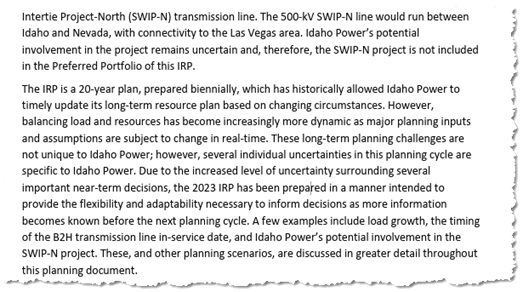
In other words, the formal planning document filed with the Idaho Public Utilities Commission (IPUC) and acknowledged in Case IPC-E-23-23 treats SWIP-North as optional, one of many, not as a critical resource without which the system fails.
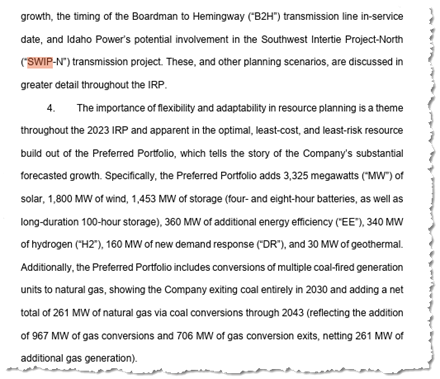
The webpage’s claim that alternatives “will cost customers millions more” goes far beyond what the record supports. That figure is not a regulatory finding of the IPUC, FERC, or CAISO. It rests instead on sponsored (paid for) economic modeling produced for LS Power and Great Basin Transmission by the Brattle Group, work designed to support DOE and FERC financing requests. Those are projections, not guaranteed ratepayer outcomes, and they depend entirely on the assumptions fed into the models. Idaho Power has never produced a public comparison showing that SWIP-North is cheaper than new dispatchable generation, expanded gas capacity, targeted transmission upgrades, or other near-load solutions.
In short, the “millions more” narrative only appears compelling if you accept Idaho Power’s self-imposed corporate preference to move away from new local dispatchable generation in pursuit of a long-term carbon-free trajectory. That policy choice is voluntary, not a statutory or regulatory mandate, and should not be presented as proof that SWIP-North is the sole affordable path for Idaho ratepayers.
Idaho Power - Point 2
“Idaho Power’s ownership interest in SWIP-North is only to bring energy into Idaho, not to sell energy to California or elsewhere.”
Response: Ummm, I think someone’s pants are on fire
This statement focuses narrowly on Idaho Power’s slice of capacity and ignores how the line is designed and financed as a whole.
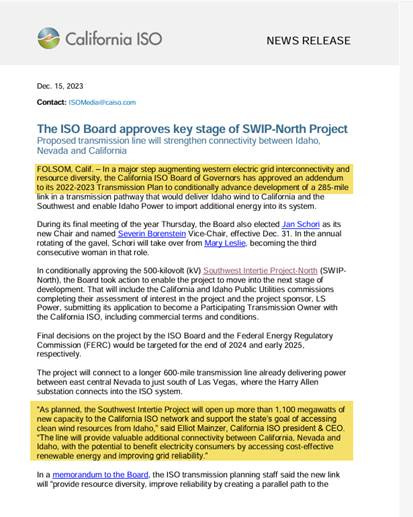
Public documents from LS Power, DOE, CAISO, and Brattle all describe SWIP-North as a bidirectional, multi-state corridor connecting the Desert Southwest, Idaho, and the Pacific Northwest so energy can move in both directions, mostly from Idaho toward California.
Here is a clear statement from California Independent System Operator (CAISO) on the purpose of the SWIP‑North project:
“The Project will provide approximately 2,000 MW of firm, bi-directional transfer capability, will connect the Idaho wind-powered generation resource to the CAISO balancing authority area by tying to the transmission system operated by a CAISO Participating Transmission Owner, and will enable load-serving entities in California to access Idaho wind-powered generation.” (CAISO, “Order accepting Development Agreement between Great Basin and CAISO re SWIP-North”, Jan 21 2025, p. 2
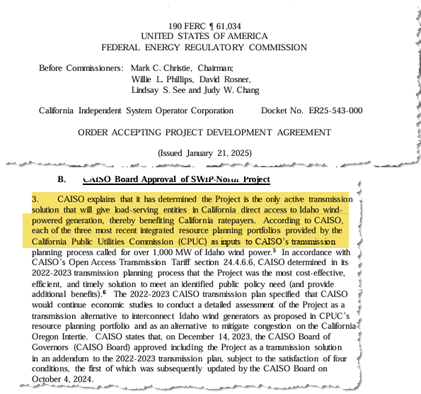
The U.S. Department of Energy describes SWIP-North as a “$1+ billion, 285-mile, 500-kV transmission line” that will “connect the Midpoint substation near Twin Falls, Idaho, with the Robinson Summit substation near Ely, Nevada, providing a new pathway for delivering energy between the Desert Southwest and the Pacific Northwest.” Utility Dive reports DOE’s characterization of SWIP-North as a “2-GW, bi-directional” line that could “help deliver wind power from Idaho to California” and connect geothermal and solar resources to Pacific Northwest customers.
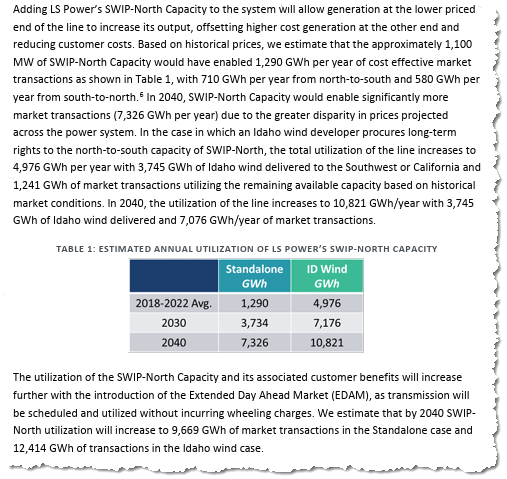
Brattle’s 2021 SWIP-North Benefits Analysis is even more explicit. It states that “SWIP North is the final link of a transmission project that would create 1,000 MW of firm transmission rights from Idaho to California for CAISO.” The Brattle 2024 Independent Market Report, used in Great Basin’s DOE Transmission Facilitation Program application, evaluates revenue from selling “Idaho wind” delivered to CAISO via SWIP-North and calculates a levelized cost of 40 dollars per MWh, with about 6 dollars per MWh attributable to SWIP-North transmission charges.
The development agreement between Great Basin Transmission and CAISO, which FERC accepted in 2025, is part of CAISO’s transmission planning to meet “public policy need” and provide “reliability and economic benefits” through the SWIP-North Project. CAISO and Great Basin are not building a one-way Idaho import spur. They are integrating SWIP-North into the CAISO grid as a bidirectional regional facility.
Idaho Power’s CPCN application underscores the narrowness of its claim. The company asks IPUC to approve ownership rights to 250 MW of northbound capacity and the use of an additional 250 MW of northbound capacity owned by GBT Northbound, for a total of 500 MW of south-to-north rights on what the filing itself calls the “Total SWIP” line. That is 500 MW out of a 2,000 MW class project. LS Power filings with Nevada show SWIP-North as a 285-mile 500 kV line with about 2,100 MW of transfer capacity, of which LS Power is “entitled to ~1100 MW from Midpoint to Harry Allen.”
So even if Idaho Power’s contractual rights are currently limited to imports, the project as designed, financed, and approved is not. It is a regional highway that others, especially LS Power and CAISO participants, can use to move energy out of Idaho and toward California markets.
Could there also be another reason Idaho bought into SWIP-N? Could it be related to recent FERC filings and cost recovery for constructing SWIP-N?
Idaho Power - Point 3
“SWIP-North gives us an opportunity to tap into the desert Southwest’s energy market, where prices fall during the winter as cooler weather reduces electricity use… SWIP-North will enable Idaho Power to import up to 500 megawatts of power from south to north… as much as 13,000 megawatts of surplus power in the winter.”
Response: Risky Speculation
The basic geography is correct: SWIP-North connects Midpoint in Idaho to Robinson Summit in Nevada. The problem is how Idaho Power presents market claims as if they were firm, low-risk facts.
The “13,000 megawatts of surplus power” is a marketing statistic, not a committed supply. Idaho Power has not identified binding, long-term contracts for winter surplus from specific Southwestern utilities at guaranteed “low cost” prices. The Brattle 2024 Independent Market Report explicitly treats price spreads and dispatch as modeled variables, not guarantees, and notes that economic benefits depend on how holders of SWIP capacity choose to schedule transactions and how markets actually clear.
At the same time, Great Basin and Brattle emphasize that SWIP-North is economically justified in large part because it lets LS Power and others export Idaho wind into CAISO. Brattle calculates the delivered cost of Idaho wind to CAISO using SWIP-North, again highlighting the export function.
Idaho Power’s CPCN filing confirms that its 500 MW of south-to-north rights are a subset of the total transfer capacity on SWIP. The rest of the 2 GW line remains available for other users and directions, especially in an environment where CAISO has accepted SWIP-North into its transmission plan and entered a development agreement with Great Basin.
So the question is not whether the Southwestern market sometimes has winter surplus. It does. The question is whether Idaho ratepayers should underwrite an interregional corridor whose full design, financing, and governance clearly anticipate significant exports out of Idaho to CAISO, while Idaho Power’s public messaging talks only about imports.
Related
Idaho Power - Point 4
“SWIP-North will help keep power costs affordable for Idaho homes, businesses, farms, and ranches.”
Response: Aspirational, Promises, Hope in One Hand…
This is an aspiration, not a binding commitment, and the record is mixed.
Brattle’s benefits analysis, prepared for Great Basin rather than Idaho Power, estimates production cost savings across the Western grid if SWIP-North is fully used. Those regional savings do not automatically translate into lower retail rates in Idaho. They depend on how capacity rights are allocated, how much of the benefit accrues to CAISO load, and how Idaho Power and LS Power recover project costs.
Idaho Power’s June 2025 investor presentation highlights SWIP-North alongside other capital projects as part of “Total System Rate Base Growth.” When a utility adds assets to rate base, the default effect is upward pressure on customer rates unless savings elsewhere more than offset the new revenue requirement.
The company’s general rate case filing in IPC-E-25-16, discussed in IDACORP’s 2025 SEC Form 10-Q, seeks substantial increases in rates and explicitly ties higher revenue requirements to capital spending and growth. While SWIP-North is not the only driver, this shows that the narrative of “keeping rates low” exists alongside filings that ask for higher rates.
In short, neither FERC nor IPUC has concluded that SWIP-North will make Idaho bills lower than feasible alternatives such as firm local generation, targeted transmission upgrades, or more distributed and near-load resources. The claim should be treated as a prediction at best, not a proven benefit.
Related
Disclaimer
This analysis uses only publicly available documents, including Idaho Power’s IRP filings, its CPCN application, Micron Technology’s petitions to intervene, federal agency reports, and published statements from Idaho Power and LS Power. The review does not claim access to confidential customer information, internal Idaho Power communications, or proprietary economic data. References to semiconductor power requirements are based on widely documented industry norms, not confidential Micron specifications. Nothing in this document should be interpreted as an accusation of wrongdoing by Idaho Power, Micron, LS Power, or any regulatory agency.
The purpose of this material is to help the public evaluate Idaho Power’s claims about SWIP North by comparing them to the official record. The analysis focuses on transparency, factual accuracy, and whether Idaho Power’s public statements are fully supported by the evidence submitted in regulatory proceedings.
Sources
- Originally published on Substack: https://jeffapierson.substack.com/p/idaho-power-swip-n-point-by-point